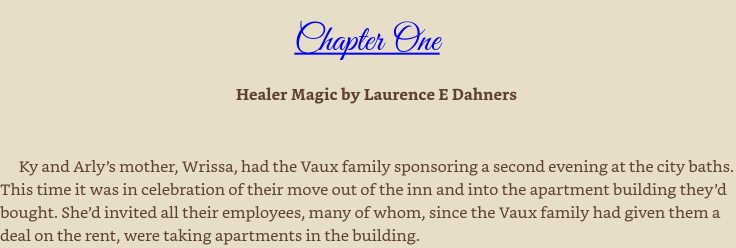
But where?
The problem with non-standard fonts is that the data must be put somewhere. What’s the data? Who knows? That could be a rendered bitmap or the entire font. Where is somewhere? Who knows? That could be embedded in the book itself or it could be a reference to AWS data, which makes the book dependent upon a live internet connection to render. And Amazon can change their mind; just because it’s embedded now doesn’t mean it will remain that way.
I’ve already succumbed to this with a paw print as the intra-chapter separator. On the bright side, the paw is part of the “Horizontal Line” style of my template. Getting rid of it everywhere is trivial: Change the template and they all change.
I have not – yet – succumbed to a custom font. It’s not beyond the realm of possibility. All the System stuff is in its own style. I’m planning to render that style as a Kindle built-in font. That hasn’t happened, yet, so there may be issues with it.
One assumes that font is part of the Chapter Heading style of a template and changing it to something standard would be simple – for the publisher. For the readers, we’re stuck.
I think I’m OK with all my intra-chapter breaks just disappearing. Maybe. I’m definitely not OK with all my chapter headings disappearing. Although, I suppose it wouldn’t be too bad. It’s clearly a new chapter by the page formatting. Is which chapter that important? Maybe not.
I think the difference is that one must do something to get an intra-chapter break. There is no default. That “something” can just be defining the style as an asterisk instead of an image, but it still needs to be done. One doesn’t need to do anything to get a chapter heading. I’m using the standard Heading 1 style with a top margin to push the start about 1/3 down the page.
Using a special font for chapter headings – they don’t even have names – seems gratuitous. On reflection, so does using a paw print as an intra-chapter break, yet I’ve done it.
This bothers me. Where “this” is both the gratuitous font change and my inability to define how it’s different from what I’ve already done.


One thought on “Drawing a Line”