Another “two” post. Unlike the first one, this one isn’t awful. The cover image is a link.
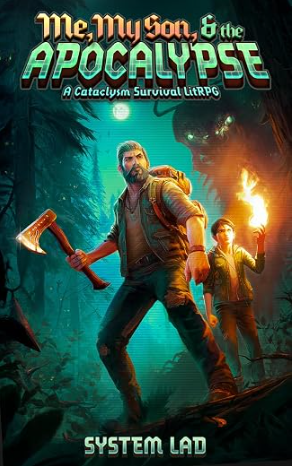
Note that the cover checks all the boxes: Weapons, Something that Glows, Monsters, Color, Not Photo-Realistic, and Serif font (sort of). (The lighting is wrong; there’s another light source about four feet above and ten feet forward of the visible one that only illuminates the father.)
It’s first-person from Dad’s point of view. So far, he’s pulling that off, which is really difficult.
There is very little “OMG! What’s happening?!?!”. While I don’t want to obsess about it, I think more than that at the start is appropriate, although not genre required.
The System is somewhat helpful: It offers quests, which let people know what they’re supposed to do next. I have purposefully left this out. My System doesn’t care what you do.
There is a lot of detailed description. An arbitrary example:
We pressed forward again, this time with fewer words. It wasn’t silence exactly, just a mutual understanding that we needed to conserve our breath and keep our focus. The terrain kept throwing obstacles at us, like the land itself was testing our resolve.
We climbed over a collapsed section of ridge where the roots of an upturned tree were still clinging to black, clay-packed soil. The trunk was massive, easily six feet wide, and its fall had left behind a steep depression that we had to traverse by scrambling on all fours. I went first again to find the best handholds and flag bad spots. When I offered Leo my hand this time, he took it without comment.
I’d write the first paragraph (properly using “as if” instead of “like”), but not the second. I’m not sure if that’s a good thing or a bad thing, but it’s definitely a thing.
I like the town encounter. I can’t just steal it because the town has been “reformatted” (for lack of a better word) while my System does nothing to Earth. I can be informed by it, though. It confirms that I have an agency issue.
Setup: I spend one page on several people’s thoughts just before the System arrives. He spends 23 on two people. It’s not wasted. We get a decent feel for dad and son before anything goes wrong. I (try) to do the same thing after things go wrong. This does need some work.
Getting Going: They start moving on page 52 (start of chapter 3). Generously, our intrepid werewolves start moving on page 26 (start of chapter 5); more realistically, page 49 (start of chapter 8).
Travelling: They arrive at the first town, which is the first goal, on page 90 (end of chapter 4). Say 40 pages for 1.5 days across a couple of miles of difficult (deep forest/jungle) – and well described – terrain. Our werewolves arrive at their first goal (SD/ND border) on page 58 (middle of chapter 8). Say 10 pages for 2 days across 500 miles of not-easy/not-awful – and sketchily described – terrain.
I kept track of this very carefully. Running top speed for a wolf is about 30mph. A racing dog can hit 80mph (YouTube has video proof of a guy on an ATV racing his dogs). Assuming you have 10 hours/day to run (which is short – wolves don’t need camps), 500/20 = 25 mph. With a System helping, that’s sustainable and still leaves 6 hours/day for fights and hunting.
I don’t think I want all the description, which is what most of the difference in page count is. At least not here. It’s not “extra” or “florid”; it’s just detailed – but not Ayla walking through a forest detailed (Clan of the Cave Bear, which I liked except when she walked through a forest).
Then there is the town. They help defend it (notified via a quest) and get this:
A notification pulsed across the top of my HUD just as he said it.
Reputation Update: Briardene Standing: Neutral → Allied Tier 1 Access Unlocked.
● Basic Workshop.
● Merchant’s Tent (limited stock).
● Tavern Rest Bonus: +10% HP/MP recovery.
pages BEFORE this happens:
“We’re not a rich town,” Noah said. “Not these days. But we’re grateful. Briardene stands because of your actions, and I don’t say that lightly.”
“Appreciate that,” I said with a small nod.
“I’ve left a standing request with the workshop team,” he added. “If you decide to stay a while, they’ll be happy to offer repairs and maybe even upgrades. As for lodging, the tavern’s upstairs loft is open. Consider it yours while you’re here.”
This throws agency for a loop. Granted, it’s possible that Noah (acting Mayor) has considered all this before he says anything and the system is reflecting the human decision, just before our intrepid father and son are aware of that human decision; it’s first-person so the reader doesn’t know. It’s also possible that Noah is “forced” into this because the system wants them rewarded. One cannot tell. I don’t like this ambiguity.
This is a problem with LitRPG that involves group building: The not-hero characters shade into NPC-ness as the heroes play at Civilization XXIV. This is very minor compared to some.
And that’s as far as I’ve gotten in the book. About twice as far, now: Chapter 9, page 173.
It’s too game-y, but I think that’s how he solved the economics problems. There are quests flying all over the place and the payoff is XP. The herbalist gives them a fetch quest to get her herbs. The blacksmith gives them a fetch quest to get him ore (does any blacksmith, anywhere, know how to turn ore into metal?). No now-useless money needs to change hands. No bartering.
Of course, the big mystery is where does the XP granted by the quest come from? If the system just generates it, won’t the economy blow up? Maybe not, because XP is not transferrable (at least not yet). All the quests are really on behalf of the system, not the person handing out the quest. Presumably they’re “sub-quests” of the quest the person handing it out got.
I don’t like this. I think because it reduces all transactions to game terms. Lord Alpha Banner (that’s our intrepid werewolf’s title) can generate quests, but he also has to generate the rewards – no XP possible (yet). No one else can (it’s a perk of the title). That used to be chapter 21, but it’s slid out. I think it’s 24, now.
This says nothing about the quality of the book. The Lit/RPG boundary moves all over the place in this genre. We just happen to prefer different balances. Frankly, the transaction-as-quest model solves so many economic problems that it’s a wonder it isn’t used more often.

